Worcester Boiler Pressure: What It Should Be & How to Fix It
Worcester Bosch boilers should show a pressure of 1 to 1.5 bar on the gauge when the heating is cold, rising to around 2 bar once it's running. Anything below 1 bar or above 2.5 bar points to a problem that's worth addressing before it causes a breakdown. Re-pressurising a Worcester boiler is usually a five-minute job using the filling loop, though pressure that keeps dropping back down within days or weeks is a sign of a leak or a fault rather than something a single top-up will permanently fix.
This guide covers the normal Worcester pressure range, what makes it drop or climb, how to re-pressurise the system safely, and when the problem needs a Gas Safe registered engineer rather than another top-up. isnuüg's Heating Plans include annual servicing and priority call-outs for exactly this kind of recurring fault.
What Should Worcester Boiler Pressure Be?
Normal Worcester pressure sits between 1 and 1.5 bar cold, rising to about 2 bar once the heating is running. Readings under 1 bar or over 2.5 bar both need attention, though for different reasons.
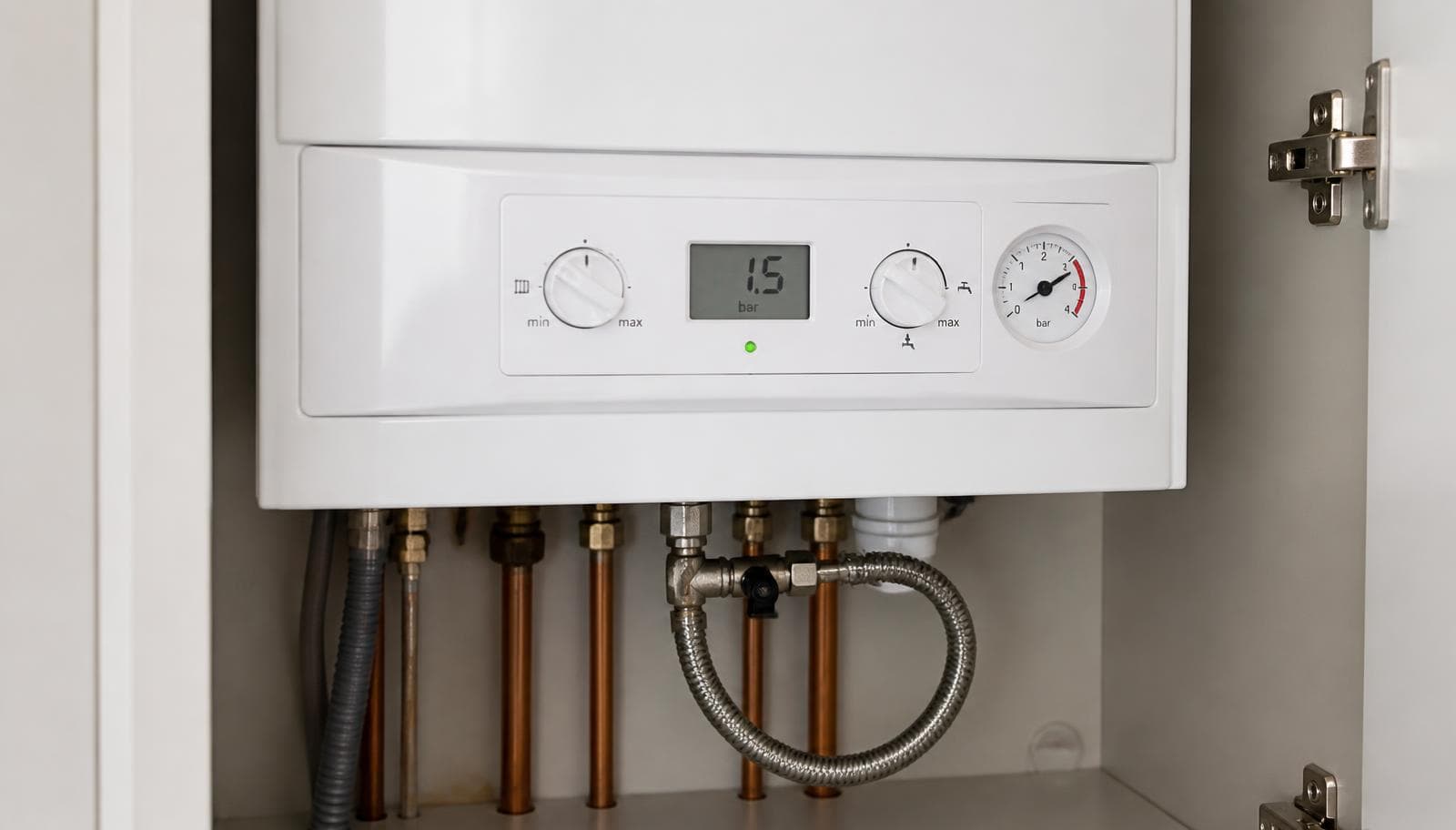
The pressure gauge is usually built into the boiler's front display, either as a traditional analogue dial or as a digital readout depending on the model. Worcester Bosch's own guidance treats topping up once or twice a year as normal, since sealed systems lose a small amount of pressure gradually over time.
A cold reading of 1 to 1.5 bar is what to check first thing in the morning or after the system has been off for a while. Once the heating fires up, the water expands as it warms, which naturally pushes the reading up towards 2 bar. That rise is expected and isn't a fault on its own; it's only a problem if the cold reading is already outside the normal range before the heating even starts.
On most current Greenstar models, pressure appears as a digital figure on the main display, sometimes alongside a small tap or droplet icon that flashes when it's low. Older models tend to use a traditional analogue dial with a coloured band marking the normal range.
- Below 1 bar — low: system needs re-pressurising, or has a slow leak if it recurs
- 1 to 1.5 bar — normal: no action needed
- 1.5 to 2.5 bar — slightly high: worth monitoring; bleed pressure down if it keeps climbing
- Above 2.5 bar — high: risk of the pressure relief valve discharging; reduce promptly
Why Is Worcester Boiler Pressure Low?
A single drop after bleeding radiators is normal and easily fixed. Pressure that keeps falling points to a leak, a faulty pressure relief valve, or a failing expansion vessel.
Low pressure almost always means the sealed system has lost water, either through a one-off event like bleeding a radiator, or gradually through a leak somewhere in the system. The most frequent causes, roughly in order of likelihood, are:
- Bleeding radiators recently, which releases a small amount of water along with trapped air
- A visible leak at a radiator valve, pipe joint, or the boiler itself
- A passing pressure relief valve, which can leak water without an obvious puddle
- A failing expansion vessel, which loses its internal air charge over time
- Very old sealed systems that have simply lost pressure gradually over several years
A one-off low reading after bleeding a radiator is nothing to worry about and is fixed with a normal top-up. A reading that falls again within days or weeks is a different situation: it's the system telling you that water is leaving somewhere, and another top-up will only buy a few more days before it happens again.
Why Is Worcester Boiler Pressure Too High?
Most high-pressure cases are simply an over-enthusiastic top-up. Persistent high pressure after bleeding it down usually points to the filling loop or expansion vessel. Unlike low pressure, which tends to develop gradually, high pressure often appears suddenly, right after someone has topped up the system. The usual culprits are:
- Adding too much water through the filling loop during a top-up
- A filling loop that hasn't been fully closed, allowing water to keep entering the system
- A faulty expansion vessel that can no longer absorb the normal expansion of heated water
- A recent boiler or radiator installation where the system wasn't balanced correctly
How to Re-Pressurise a Worcester Boiler
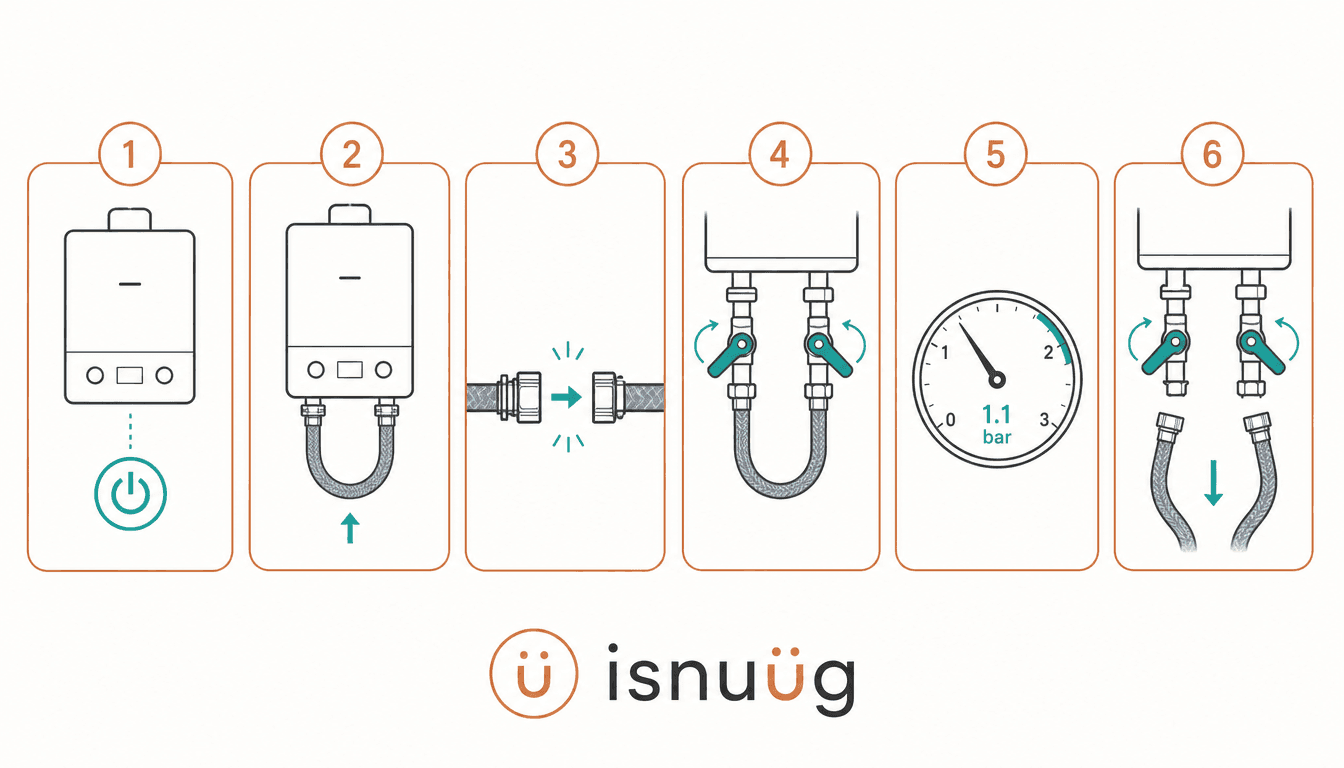
Turn off the heating, connect or open the filling loop, top up slowly while watching the gauge, then close the loop firmly once it reaches 1 to 1.5 bar. The filling loop is a braided hose, sometimes permanently attached and sometimes stored separately, that connects the mains cold water supply to the sealed heating system.
You'll need access to the filling loop, a cloth or towel in case of minor drips, and usually no tools beyond turning the loop's valves by hand.

- 1
Turn off the boiler
Let the system cool if it's been running recently.
- 2
Locate the filling loop
Usually a grey and blue braided hose beneath the boiler.
- 3
Attach the loop
If it's detachable, make sure both ends are pushed on firmly.
- 4
Open both valves slowly
Listen for water entering the system.
- 5
Watch the pressure gauge
Close the valves as soon as it reaches 1 to 1.5 bar.
- 6
Disconnect and check
Remove the loop if removable, and check the display for any remaining fault codes.
Re-pressurise at a glance
If you already know the process, this quick visual summary of the filling loop steps can be saved or shared as a quick reference when the pressure gauge drops below 1 bar.
What If Re-Pressurising Doesn't Fix It?
A recurring drop needs tracing, not repeated top-ups. Pressure that returns to normal after a top-up but drops again within days or weeks means there's an active leak or a failing component somewhere in the system. At that point the fault is unlikely to be something a homeowner can locate without draining down parts of the system, and a repeated top-up simply masks the problem for a few more days each time.
A few patterns are a reliable signal that it's time to stop topping up and get the system looked at:
- The pressure drops back to the same low reading more than twice in a month
- You can see water pooling near the boiler, a radiator valve, or a pipe joint
- A fault code appears on the display alongside the low reading
- The boiler has needed re-pressurising more often over the past few services than it used to
“A tradesperson paid for a single call-out has little reason to keep tracking a fault that comes back next month. We stay responsible for the system for the life of the plan, so tracing a recurring pressure fault properly is in our interest as much as the homeowner's.”
Worcester-Specific Error Codes Linked to Pressure
H07 means low pressure specifically. Other codes like A1 or E9 can be pressure-related but usually point to a different underlying fault.
- H07 — system water pressure too low: directly pressure-related
- A1 — pump stuck or running dry: sometimes, if low pressure is starving the pump
- E9 — overheating protection triggered: occasionally, if poor circulation is linked to pressure loss
If H07 appears, re-pressurising as described above usually clears it. If A1 or E9 appears without a clearly low pressure reading, the cause is more likely a separate mechanical fault, and that's a job for a professional rather than a DIY fix. Recurring faults like this are exactly what's covered under isnuüg's warranty and cover terms.
Keeping Your Worcester Boiler at the Right Pressure
A Worcester boiler running at 1 to 1.5 bar cold, rising to around 2 bar when heating, is doing exactly what it should. A single low reading after bleeding a radiator or a slightly high one after a top-up is nothing to worry about, and both are simple to correct using the filling loop in a few minutes.
What matters is noticing the difference between a one-off adjustment and a pattern. Pressure that keeps returning to the same low reading week after week is telling you something specific: there's a leak, a failing valve, or a component that needs replacing, not just topping up.
Key Takeaways
- Normal Worcester boiler pressure is 1 to 1.5 bar when cold, rising to about 2 bar once the heating is running.
- Below 1 bar usually means the system needs re-pressurising, or has a slow leak if it keeps happening.
- Above 2.5 bar risks tripping the pressure relief valve and should be brought back down.
- Re-pressurising uses the filling loop and typically takes under five minutes.
- Pressure that drops repeatedly within days or weeks points to an underlying fault, not normal wear.
- isnuüg's Heating Plans include annual servicing and priority call-outs for recurring pressure issues.
FAQ
What pressure should my Worcester boiler be at when the heating is on?
Around 2 bar is typical once the system is up to temperature, compared with 1 to 1.5 bar when cold. This rise is normal and happens as the heated water expands.
Why does my Worcester boiler pressure keep dropping?
A single drop after bleeding a radiator is normal. Pressure that falls again within days or weeks points to a leak, a passing pressure relief valve, or a failing expansion vessel, and needs tracing rather than repeated top-ups.
Is 2.5 bar too high for a Worcester boiler?
Yes. Above 2.5 bar risks the pressure relief valve discharging water to prevent damage, so it's worth bleeding the pressure back down towards 1.5 bar promptly.
How often should I check my boiler pressure?
A quick glance at the gauge every month or so is enough for most households, along with a check any time the heating feels less effective than usual.
Can I re-pressurise a Worcester boiler myself?
Yes, using the filling loop, and it's a routine five-minute task for most homeowners. If the pressure won't hold or keeps dropping, that's the point to stop and get it looked at rather than continuing to top it up.
Is isnuüg a legitimate company to fix a boiler pressure fault?
isnuüg is Gas Safe registered and holds accreditations including CHAS Premium Plus, Constructionline Gold, and ISO 9001, 14001 and 45001. Recurring faults like pressure loss are exactly what the annual servicing and priority call-outs in a Heating Plan are built around, rather than a one-off visit that doesn't follow up.
What's the difference between calling a one-off engineer and using isnuüg for a pressure fault?
A one-off call-out fixes the symptom on the day and has little incentive to trace a fault that might resurface later. isnuüg stays responsible for the system for the life of the plan, so tracing the actual cause of a recurring pressure drop is built into the service rather than being an extra cost each time.