What Is a Smart Thermostat? A Beginner's Guide
A smart thermostat is a connected device that replaces your existing wall control and, on older systems, the timer too. It lets you schedule, adjust and check your heating from a phone rather than a dial on the wall. Instead of a fixed on-off pattern you set once, you get a schedule you can change from anywhere. Some models go further, learning your routine or noticing when everyone has gone out.
This guide covers what a smart thermostat does, what's inside the system and whether your boiler will work with one. For costs and savings in more depth, see our full smart thermostat guide, or our comparison of UK models.
Quick Summary
- A smart thermostat replaces your wall control with a connected device you can schedule and adjust from a phone
- Some models learn your routine or turn the heating down when everyone's out, though not all do, and some charge a subscription for it
- Most models work with combi, system and regular boilers, in wired or wireless versions
- You'll need home wifi and a smartphone for the remote and scheduling features
- Basic single-zone kits start from around £150, and room-by-room systems cost significantly more
- How well it performs depends as much on the boiler and system behind it as on the thermostat itself
What Does a Smart Thermostat Actually Do?
A smart thermostat lets your heating respond to what's happening at home, instead of sticking to a schedule someone set once and forgot about.
Underneath the app and the display, it can do three things a traditional dial or timer can't, though not every model does all three.
Learning Your Routine
A few models build a schedule for you. Google Nest thermostats watch the temperatures you choose and, by Google's own account, have learned your preferences after about a week. Most others, including Tado, Hive and Drayton Wiser, follow a schedule you set in the app. Some of them can still learn how long each room takes to warm up, so it reaches temperature on time.
Adjusting Automatically When You're Out
Some models use your phone's location to tell when everyone has gone out. They turn the heating down as you leave and back up as you head home. Depending on the brand, that happens automatically, only with a paid subscription, or as an alert on your phone so you can decide.
Controlling It From Your Phone
Because the thermostat connects to home wifi, you can check and adjust it from anywhere. You might turn the heating on before you leave work, or check it's off while you're away.
How Is It Different From a Normal Thermostat?
A manual dial only changes when someone turns it, and a basic timer follows its schedule whether anyone is home or not. A smart thermostat can respond to what's happening in the house, from your phone or, on some models, by itself.
The practical difference comes down to how much each type reacts to real life rather than a schedule set once and left alone.
| Type | How it behaves | Main limitation |
|---|---|---|
| Manual dial | Stays at whatever temperature it was last set to | Only changes when someone adjusts it by hand |
| Basic timer | Switches the heating on and off to a fixed schedule | Keeps heating an empty house if plans change |
| Smart thermostat | Runs a schedule you control from an app, and some models react when people come and go | Needs wifi and a smartphone for its full set of features |
None of this replaces a working boiler. It makes a properly maintained system run closer to how the household lives, which is where any savings come from.
What's Inside a Smart Thermostat System?
A typical system has three parts: the thermostat, a hub or receiver that talks to the boiler, and optional room sensors or valves for zone-by-zone control.
The wall-mounted display is the part most people picture, but it's usually only one piece of the setup.
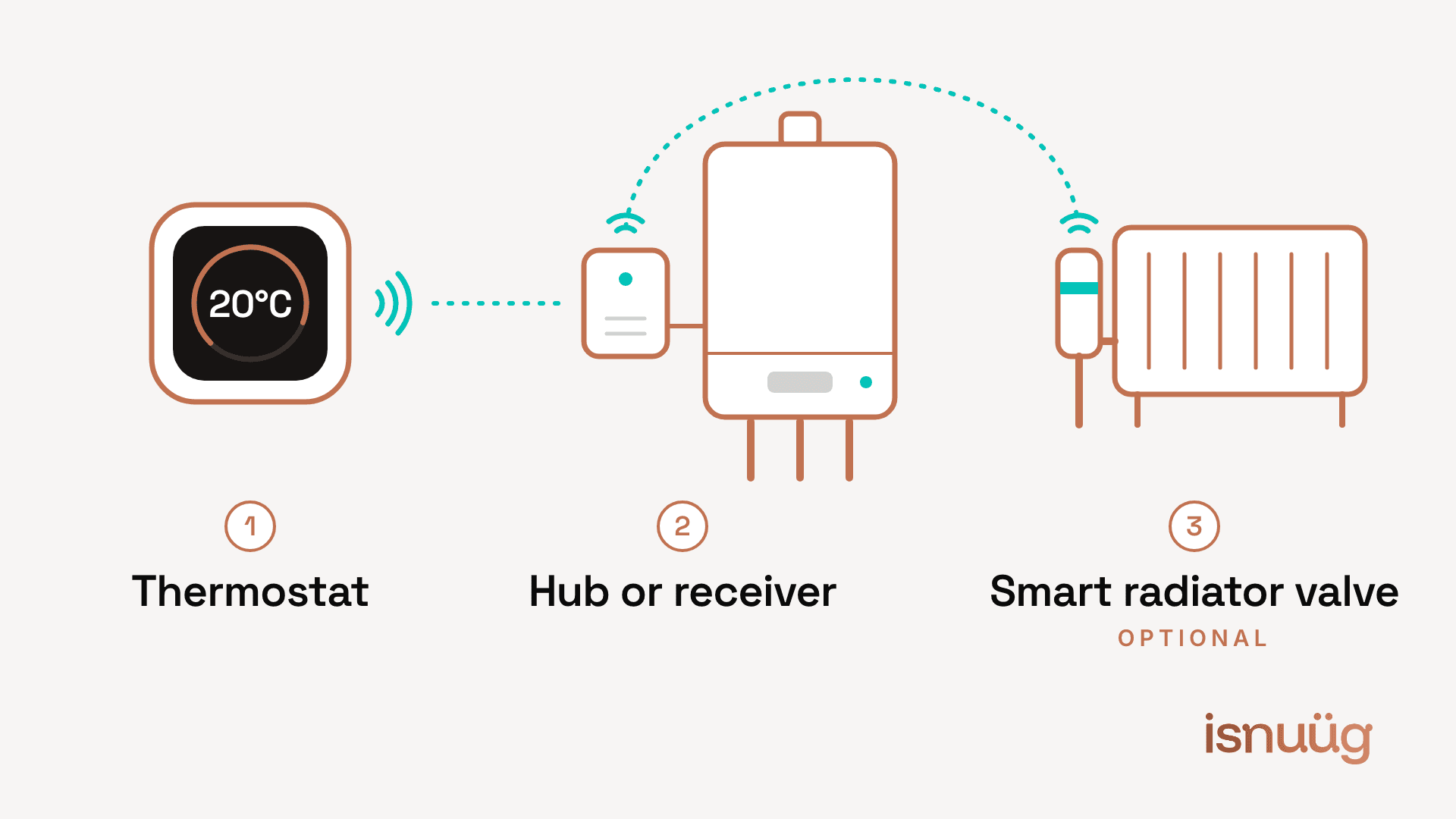
The Thermostat Unit
This is the part fixed to the wall or left free-standing. It shows the current temperature and gives you touchscreen or dial controls, alongside the mobile app.
The Hub or Receiver
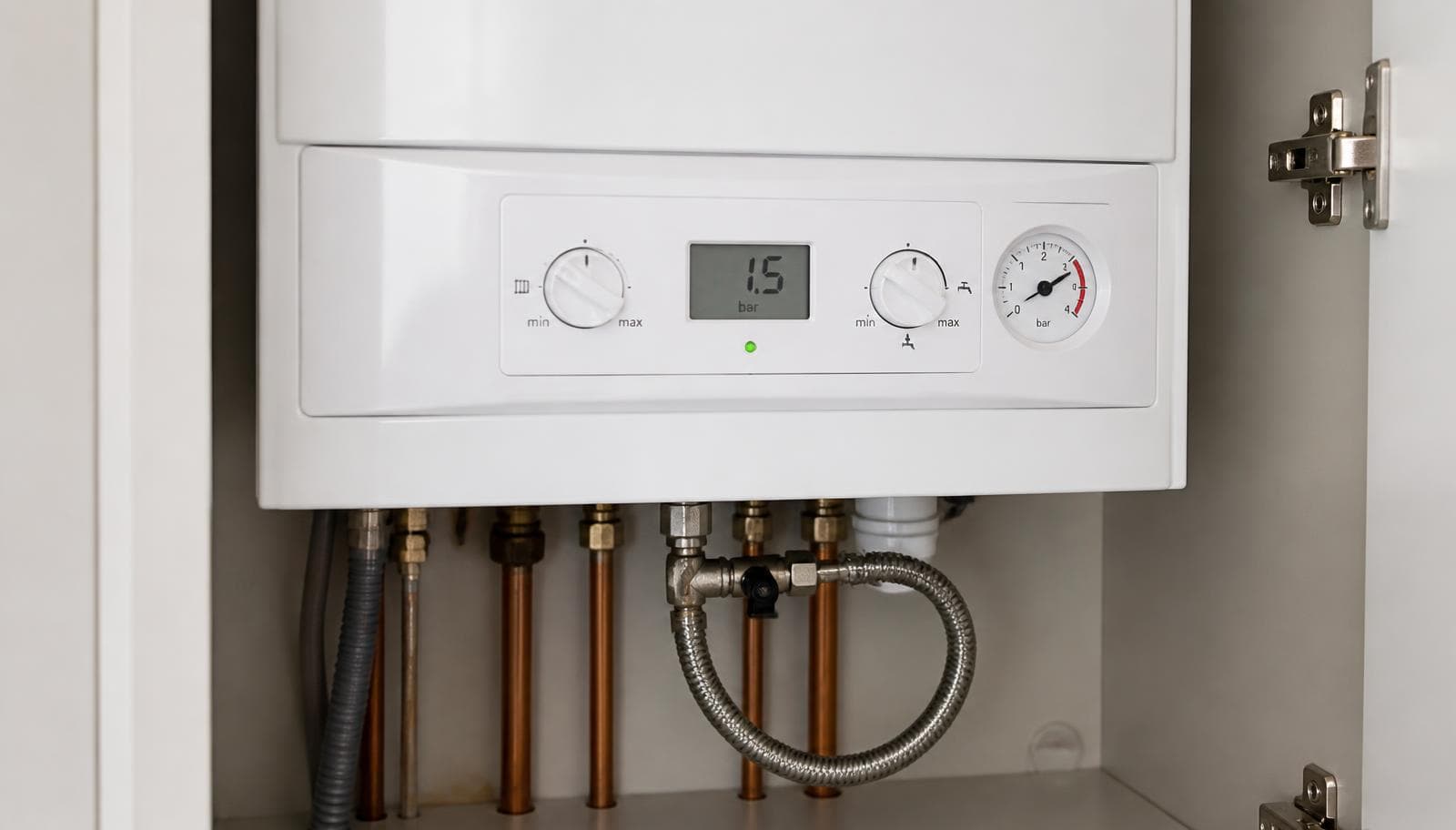
A small box, usually fitted near the boiler, turns the thermostat's instructions into signals the boiler understands. On some systems that box also connects to your wifi, while others add a small hub or bridge plugged in near your broadband router. Some wired thermostats do without the boiler box altogether and connect through the wiring your old thermostat used.
Optional Room Sensors and Valves
If you want different rooms heated on different schedules, you can usually add smart radiator valves or room sensors later. They don't need to be part of the first kit.
Will It Work With My Boiler?
Most smart thermostats work with combi, system and regular boilers. Wired and wireless models connect in different ways, and both need decent home wifi to use their full features.
Compatibility questions come up early for most people, and the good news is that boiler type rarely rules a model out entirely. What varies more is how the thermostat connects, and what it needs from the rest of the house to work.
Checking Compatibility
Several manufacturers, including Tado and Google Nest, publish online compatibility checkers that ask a few questions about your boiler and wiring. It's the quickest way to confirm a specific model will work, and it takes a couple of minutes. It also avoids a common mistake: buying a thermostat first and checking compatibility once it has arrived. Where a brand has no checker, its installers confirm compatibility on the visit.
Wired vs Wireless Models
Wired versions connect directly into the boiler's existing controls. Wireless versions talk to a receiver by radio, which can be easier to retrofit where running a new cable isn't practical. Some kits are designed for DIY fitting, but the connection at the boiler end usually means working with mains wiring. Unless you're confident with electrics, it's a job for a qualified installer.
Wifi and a Smartphone
Before installation day, check two things: a stable wifi signal where the hub or thermostat will sit, and a smartphone for everyone who adjusts the heating. A weak signal in that spot can cause dropouts, and you can test it in advance with nothing more than your phone.
What Do They Cost, and Is It Worth It?
A basic single-zone thermostat is the cheapest way in, and systems built for room-by-room control cost considerably more. Whether it's worth the money depends more on your routine than on the device.
The price tells you more about how many rooms a system can control independently than about which brand is behind it.
What They Cost
A single-zone thermostat, enough for a flat or a smaller home with one heating zone, typically costs around £150 to £250 supplied. Systems built for room-by-room control, where different rooms run on different schedules, cost more once you add the extra radiator valves or sensors. For a larger home that often runs into several hundred pounds. Professional fitting usually costs extra, and it's worth budgeting for rather than treating as optional.
Some brands also sell an optional monthly subscription for extras such as automatic away mode or suggested schedule changes. Check which features need one before comparing prices.
When It's Worth It
It tends to pay off fastest in households with an irregular routine, such as shift work or a home that's often empty at unpredictable times. That's exactly the gap a fixed timer can't cover. It matters far less for a household that sticks to the same schedule every day. There, a smart thermostat mostly automates something that was already working well.
For typical savings and how isnuüg's Heating Plans fit in, see Smart Thermostats Explained. If you're ready to look at specific options, see which model suits which home.
Does It Matter Who Installs It?
A poorly wired or badly positioned thermostat can undermine even an expensive model, so who fits it matters as much as which model you choose.
Wired incorrectly, set up badly or fitted in the wrong spot, any thermostat will struggle to deliver the savings it promises.
A typical example is mounting it too close to a radiator or in direct sunlight. It then reads the room as warmer than it is and switches the heating off early. None of this shows up in the app. It shows up as a house that never quite feels warm enough, with no obvious cause.
Manufacturers generally recommend fitting it about 1.5 metres from the floor in a well-used room, away from radiators, direct sunlight and draughts. The Energy Saving Trust adds that curtains and furniture shouldn't block the air around it.
Every isnuüg Heating Plan includes an annual boiler service, breakdown cover and a full system flush. That gives a smart thermostat a properly maintained boiler to work with, rather than one it has to compensate for.
Getting Started With a Smart Thermostat
A smart thermostat replaces a fixed schedule with one that fits how a household lives. It uses a wall-mounted unit, a hub or receiver and, depending on the model, extra room sensors or valves. Most work with the boiler types found in UK homes. Setup mainly comes down to solid wifi coverage and a smartphone for everyone who adjusts the heating.
Whether it's worth installing depends far more on the household's routine than on any spec sheet. How well it performs depends just as much on the boiler behind it as on the thermostat itself.
To see what an isnuüg Heating Plan would look like for your home, get a personalised quote.
This article is provided for general guidance only. Prices and specifications are indicative UK figures based on manufacturers' published prices in September 2026 and may vary by retailer and property. Always confirm compatibility with a Gas Safe registered engineer before purchasing or installing a smart thermostat.
FAQ
Do I need a hub for a smart thermostat to work?
It depends on the brand. Most systems have a unit near the boiler that controls it. Some also need a small hub or bridge by your broadband router to reach the internet. Hive, for example, uses both, while Drayton Wiser combines them in one box.
Can I use a smart thermostat without wifi?
Up to a point. The major brands keep running their saved schedule if the internet drops, and you can still change the temperature on the thermostat itself. Until the connection returns you lose the app, remote control and location-based features, which are a big part of the appeal.
Is a smart thermostat the same as a smart meter?
No. A smart meter measures the gas and electricity you use and sends the readings to your supplier automatically, so your bills aren't estimated. It doesn't control your heating, which is what a smart thermostat does. They're separate devices, even though they're often confused.
Do smart thermostats work with every type of boiler?
Most work with combi, system and regular boilers. Always check a specific model with its manufacturer before buying, using its online checker where there is one, particularly for older or non-standard installations.
How long does it take a smart thermostat to learn my routine?
Only some models learn a routine. Google says its Nest thermostats have learned your preferences after about a week of normal use, and they keep adjusting after that. Most other models, including Tado, Hive and Drayton Wiser, follow the schedule you set from day one.
Do isnuüg's Heating Plans work with smart thermostats?
Yes. You don't need a smart thermostat to take out a plan, but isnuüg plans are compatible with major smart thermostats, including Tado and Hive. See Plans & pricing for what each plan includes.
Why does the boiler matter if I'm getting a smart thermostat?
The thermostat only decides when the boiler runs. A boiler that's overdue a service, or a system clogged with sludge, uses more energy to deliver the same warmth, whatever the thermostat says. Every isnuüg Heating Plan includes an annual boiler service and a full system flush, so the thermostat has a well-maintained system to control.
Sources and further reading
- Google Nest Help: How Nest thermostats learn
- Tado Help Centre: Where is the best place to install my Wireless Temperature Sensor X?
- Energy Saving Trust: Take control of your heating at home
- Energy Saving Trust: Heating controls
- Smart Energy GB: What is a smart thermostat?
- Gas Safe Register: Find an engineer or check the register